

As a physician, I spent nearly thirty years in private practice, watching patients weigh their health against their bank account. Too often, they had to choose the bank account.
It’s sad to see Americans have to make that choice.
Congress has a real opportunity to improve our healthcare system, giving patients greater confidence, more choices, and meaningful relief.
With August recess upon us and campaign season right behind it, many voters will ask a simple question: How are Members improving our healthcare system?
A President Already Delivering Results
President Trump brought pharmaceutical companies to the table voluntarily to lower costs, launched TrumpRx, and expanded the platform to include generic medicines, giving patients a direct, transparent way to buy prescriptions without a middleman setting the price. He is now pushing for insurer transparency and to end decades of foreign governments exploiting the cost of American innovation and shifting the cost onto U.S. patients.
Those are real wins—proof that we can lower costs and put patients first while promoting American healthcare leadership and innovation.
The Polling is Nearly Unanimous
Now, Congress does not have to guess what policies patients want next. Our polling makes it clear.
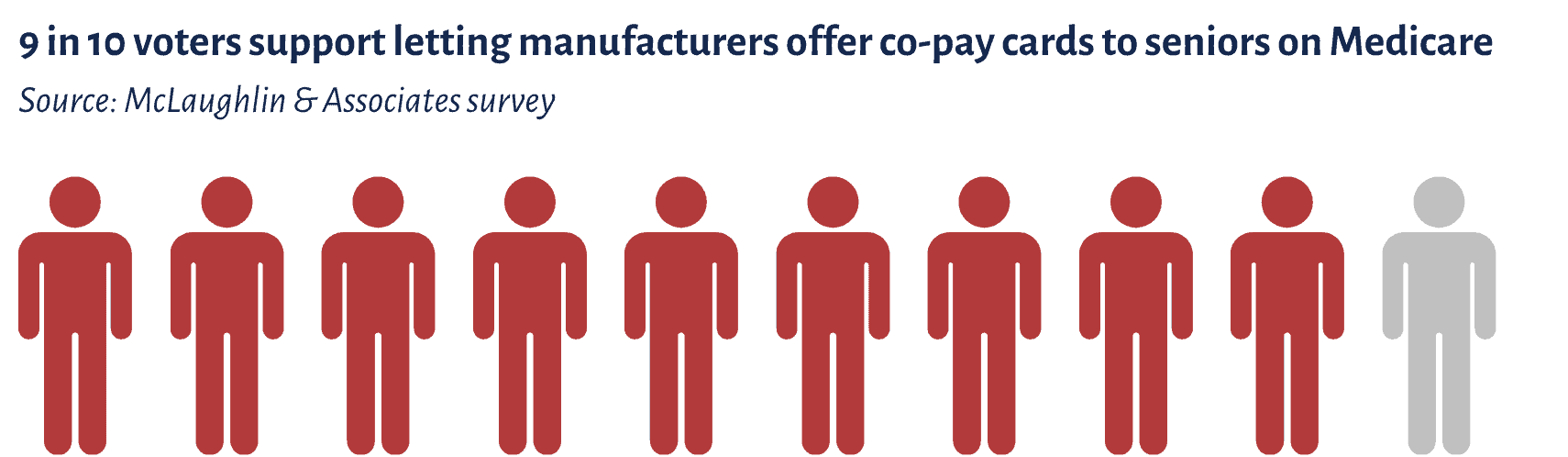
At a time when Americans agree on very little, a McLaughlin & Associates survey found close to nine in ten voters support allowing manufacturers to offer co-pay cards to seniors in need on Medicare.
Picture a 74-year-old on a fixed income in Cincinnati filling five prescriptions a month. The ability to use a co-pay card could cut her pharmacy bill by more than half. That is money she could use for rent, groceries, or whatever else she may need, and it is just the first of several reforms voters want Congress to consider.
More Pocketbook Relief at the Pharmacy Counter
The same survey found voters just as eager for additional pocketbook solutions that put savings directly in patients’ hands. Eighty-six percent support expanding discounted cash-pay pricing through a government website, giving patients a simple way to compare their options and choose the lowest available price instead of guessing what insurance will cover.
Think of a self-employed contractor in Tampa on a high-deductible plan who needs cholesterol medication. His insurance may not cover it until he meets his deductible or other criteria. A government cash-pay website allows him to compare discounted cash-pay prices before visiting the pharmacy counter, rather than walking in without knowing what he will owe.

Making Savings Actually Count
Price transparency only goes so far if a single bad month at the pharmacy can still derail a patient’s budget. Eighty-three percent of Americans back a flat, income-adjusted out-of-pocket cap for each Medicare prescription, one trip to the pharmacy should not drain an entire month’s budget.
For a retiree in Des Moines managing a chronic condition, a $400 co-pay for one specialty medication can force a choice between treatment or groceries. An income-based cap would give her certainty before she visits the pharmacy counter.

Cash-pay credits need the same fix. Right now, if a patient buys medication through a direct-to-consumer platform like TrumpRx because it costs less than going through insurance, none of that spending counts toward her deductible or out-of-pocket maximum. Rep. Greg Murphy’s H.R. 8270 Every Dollar Counts Act closes that gap, so a patient who finds a better price on their own isn’t penalized for it. Eighty-three percent of voters back the idea.
Take a 54-year-old in Charlotte managing rheumatoid arthritis. Their insurance covers their biologic, but the copay through their plan runs $340 a month. They find the same drug for $210 through a cash-pay platform and switch to save money. By December, they’ve paid over $2,500 out of pocket — enough to have cleared their deductible if it counted. Because they paid cash, it doesn’t. They head into January owing the full deductible again, penalized for the exact behavior — shopping for a better price — the system should be rewarding.

Numbers like that are rare in Washington, showcasing that these are common-sense solutions that meet patients where they are. Members of Congress from either party and every part of the country can take these ideas home and show their constituents they are working to lower costs in a way people can actually feel.
End Foreign Exploitation
Fixing what happens at the pharmacy counter is only half the job. The other half is making sure American patients aren’t the ones covering costs not paid by other countries.
For years, other countries have priced American-made medicine below cost and let U.S. patients cover the difference. Seventy-three percent of voters have had enough and support legislation that finally end foreign exploitation on U.S. drug innovation. Rep. Jodey Arrington’s H.R. 4780 USTRx Act takes that fight head-on. Advancing legislation like this can help lower costs for American patients while protecting the innovation that produces new treatments and cures.

The Choice for Congress
Ask any Member up for reelection this fall whether they’d rather explain a ‘no’ vote or a ‘yes’ vote on cutting a senior’s pharmacy bill in half or holding foreign governments accountable for exploiting our research and innovation.
Congress can deliver affordable, world-class care for every American without surrendering America’s leadership in medical innovation. That happens through competition, transparency, and market-based reform, not bigger government programs. Congress has the polling, the legislation, and a President already leading the way. All that is left is the vote, and the chance to keep America the best place in the world to be a patient.
